Preloader

How Much Salt Do I Need in Diet ?

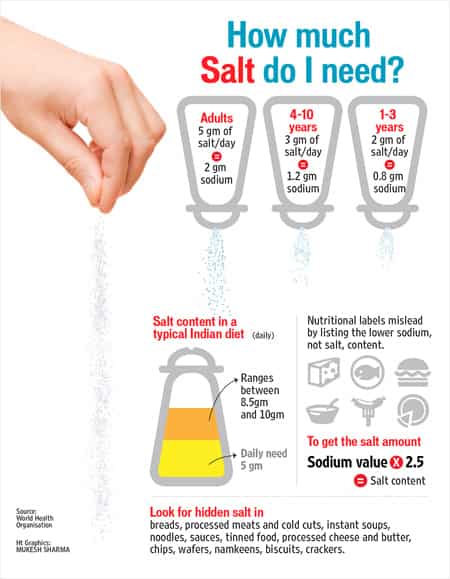
How much salt should I eat? It’s a question most of us ask physicians when our blood pressure creeps up and we are forced to acknowledge we can’t live forever. The answer is: Use added salt as little as possible. Here’s why. Use added salt as little as possible because sodium, the active component of salt, is present in almost everything we eat that is not raw. Our body needs some amount of salt, about 3 gm each day, of which between 1 gm and 1.5 gm from food naturally. The added intake, says the World Health Organization, should not be no more than 5 gm about one level teaspoon – a day. A typical Indian diet contains between 8.5 gm and 10 gm of salt a day. Cutting back on salt is far more difficult. Unlike sugar, salt finds insidious ways of creeping into your body. Saltiness is not an indicator as sodium is added to most processed and packaged food, including breads, to enhance taste, give texture and bind in water, which helps add bulk to a product.

Some amount of sodium is needed to maintain the body’s fluid balance, transmit nerve impulses and help muscles contract and relax. The kidneys balance the body’s sodium level, holding on to it when blood levels fall and excreting it when the levels are too high. But when sodium remains high, the kidneys can’t pump it out fast enough. Excess sodium causes water retention, at times adding up to one litre of water to the blood volume in a day, making the heart work harder and increasing pressure in your arteries.

Apart from making the body appear bloated, the added blood volume raises blood pressure, leading to higher chances of heart attack, stroke, congestive heart failure, cirrhosis and chronic kidney disease. One in three adults in urban India and one in five in rural India have chronic high blood pressure, which is a risk factor for heart disease and stroke, which are the leading cause of death in India.

Recent Blogs

Case Discussion: SAP (Serratus Anterior Block) Rigid Thoracoscopy

Case Discussion: SAP (Serratus Anterior Block) Rigid Thoracoscopy

Case Discussion SAP (Serratus Anterior Block) Rigid Thoracoscopy Two patients with recurring…

Demystifying young India’s heart health

Demystifying young India’s heart health

Demystifying young India’s heart health 1) WHAT IS THE DIFFERENCE BETWEEN A…
How Much Salt Do I Need in Diet ?

How Much Salt Do I Need in Diet ?

How Much Salt Do I Need in Diet ? How much salt…

Open For Appointments

We are delighted to announce that our doors are open, and we are now accepting appointments to serve you better.

our affiliations

Trusted Partnerships for Accessible, Quality Care

Our partnerships with insurance providers, government programs, and corporates ensure that patients receive smooth, affordable, and hassle-free medical support.

Insurance & Cashless Facilities

PMJAY / Ayushman Bharat

CGHS / DPT / Railways

Corporate Tie-Ups

Appointment Available Today !

X